
Decorating fast and slow
Weighing the invisible costs of material things


“There are times when it’s clear to me that by getting and spending, we lay waste our powers,” writes Rebecca Solnit, referencing William Wordsworth, “and times when, say, the apricot velvet headboard against the lavender wall of a room in an old hotel fills me with a mysterious satisfied pleasure in harmonies of color, texture, atmospheres of comfort, domesticity and a desire to go on living among such color and texture and space and general real estate.”
This is a tension I think of often, and it has been especially front of mind this year as I’ve embarked on a few upgrades around our apartment. Every object we acquire comes with a cost beyond the monetary — notably what Lloyd Alter calls upfront carbon. (He has, in fact, written the book on this.) Many people think about the environmental impacts of disposing an item (landfill), but these are usually far outstripped by the material impacts of creating it.
Let me give you the example of a book, because it’s something I have come to know far too much about. Together with my co-conspirator EJ at New Society Publishers, I developed a carbon calculator to sort out this very thing. Here’s the breakdown of emissions for a single 208-page book printed in Canada on 100% post-consumer waste paper:
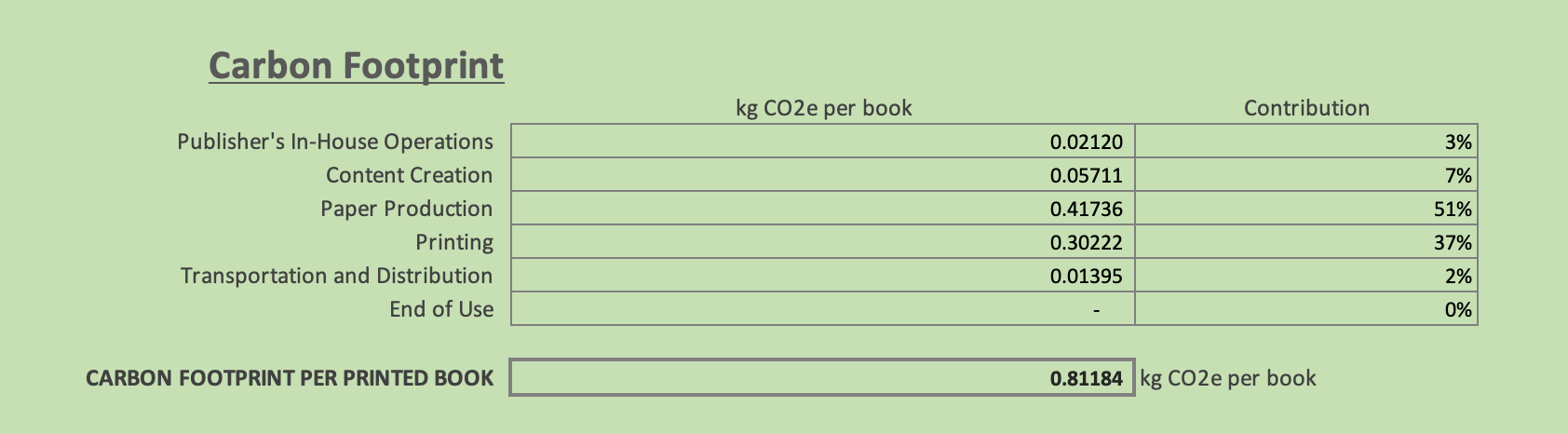
Notice that “end of use,” aka destruction (in this case, recycling/pulping), is a negligible amount of the total. 98% of the emissions are in making the book itself. Which is why avoiding waste is great, but we’re focusing on the least important thing. (We’ve talked about a similar bias with packaging.) Also, production is where worker rights and local communities are mostly impacted, though it should be said it’s often marginalized communities who live next to landfills and poorer countries that are receiving cargo ships packed with the waste of wealthy nations.
How to balance my desire for beauty and comfort against the chilling material churn of the world? I’ve written before about the fast-decor industry (go check it out if you weren’t in this gang in 2021), and my approach around home decor is still pretty much the same: I generally start with tidying/cleaning/repairing/repurposing, then turn to sourcing secondhand, then buying new responsibly, and lastly buying new irresponsibly. If anything, I err on the side of not buying something, because I am nothing if not stubborn and willing to suffer. (It’s the only way I am still Catholic.)

But at a certain point, my partner convinces me of something or I simply reach the end of my rope. In a country with a housing crisis, you can start to feel trapped, doomed to live in the same space until you die (or, in the case of renters, are evicted). While I am very fortunate to have an affordable apartment with a huge garden, decades of incompetent, sloppy landlord repairs combined with a decade and a half of wear, tear, and unavoidable grime, and no square footage to escape my own mess, means sometimes this space where I live and work feels a little heavy.
So if, like me, you want to consume mindfully, how do you know when it’s time to act, even if it means buying something new?
Consider what I’m calling “house neutrality.” I aspire to things being at least okay. Maybe they don’t spark joy, but they get the job done. If something falls beneath my baseline, becomes a real pain point (functionally or aesthetically), I start to consider improvements, working up the eco-impact chain. Sometimes, too, Le Curb or the thrift gods bestow me with a gift (see: the $125 H&M muslin duvet cover I recently scored for $3) and I pick up something I don’t need because I consider it a carbon freebie. This policy also handily keeps me off the hedonic new-things treadmill. (There will always be something nicer than what you have.)
This year on Labour Day, I undertook my biggest home upgrade project since moving here: painting my kitchen cabinets. Things were topsy turvy for three days as I relocated the contents of the cupboards onto every other available horizontal surface, but my kitchen had long fallen well below neutrality into acrimony. Inspired by my friend Jess, I had already scored some secondhand peel-and-stick backsplash on FB Marketplace, which kicked off this whole project. It made a big difference but also really highlighted how disgusting the cupboards had become. While we were living in this chaos, I also spray-painted our ugly ’70s range hood, disgusting fridge handle, and rusting, cursed baseboard heaters, and freshened up my bathroom cupboards and rotting windowsill with the remaining kitchen paint. With this momentum, I made a few other small changes, all from secondhand stuff or “shopping my home,” that tied things together. It gave me pretty dramatic psychic relief, and regular visitors tell me it has a big impact. No longer, on a bad day, could I tell myself the story that I was doomed to live in a slow and steady home enshitification.
For those who want the visual, here’s the kitchen before most of its glow-up (though after we installed the fake backsplash). If I filmed closer to the cupboards you’d see how filthy and peeling they are.
And here it is after. If you’re playing spot-the-differences, you can see changes to the cupboards, the stove fan, the nasty fridge handle, and a repaired drawer.)
In her excellent newsletter, Rosie Spinks recently wrote about how every month or two she and her husband undertake “quality of life upgrades,” little projects that take less than two hours and cost less than £40:
Changing the too-bright kitchen lights to warm dimmable bulbs. Getting a cabinet to organize all the detritus that collects by the back door. Putting WD-40 on the squeaky doors that always threaten to wake up our kid. Power washing our patio. Taking down the eyesore of a baby gate we don’t even need anymore. Putting some wood chips down around the bare patch of soil in our back patio that doesn’t get enough sunlight. And wow, the way these small things can improve your entire life. Sure, it’s not a kitchen remodel, but if you make a list of these things and cross one off each time you have a free Sunday, it makes a big difference.
There is satisfaction, too, in repairing something that was a quiet pain point. Everyone deserves a little W. I can’t repair democracy, but I can lube my bike chain.
So above all, I go slowly. If you’re moving slowly, you can often figure out if you’re chasing a trend, if you’re feeling sad or bored or insecure or unfulfilled, if you’ve been sucked into what Anne Helen Peterson calls “the optimization sinkhole” (a way to fritter away your life under the auspices of enhancing it). Shopping secondhand forces you to slow that roll — one-click ordering with free shipping isn’t available. You open yourself to chance, to creative thinking, and along the way you develop your own taste and intuition. This is, I’d like to believe, the secret to spaces that aren’t just nice but interesting and memorable (and, of course, affordable and sustainable).
A small example from this year of micro-upgrades: Recently we needed a new kitchen compost bin. My partner had repaired our old city-provided one countless times, extending its life by a couple years, but it was now beyond repair. After a couple weeks of scanning Facebook Marketplace, I went to Value Village, where I found a black metal bathroom trash can, with an inner bin with a handle. This was a great replacement, because we keep our compost bin on the floor, and the foot pedal is useful when our hands are full of kitchen scraps. There was a small dent in the top, which you can’t really see, and I’m fine with a little denting — sometimes taking home the hurt item is what keeps it out of landfill. The cost of this elegant solution? $2.50 and thinking slightly outside the box. (On the same visit, I bought a brass ibis, which needed the simple repair of one screw to be a delightful addition to my bookshelves.)
I try to hold myself to a high ethical acquisition standard, but when my plunger breaks that’s not something I’ll be sourcing secondhand. (A real example from the other day.) I also try to let some things go, because I lean toward rigidity and I live in a world where most people don’t give a second thought to the footprints of their consumption.
Above all, I try not to lose sight of the forest for the trees: We are two people and one cat in a 600-square-foot apartment in a walkable neighbourhood with no car. The environmental footprint of our housing and transport is minimal, and obsessing over every small thing means I’m on the fast track to being a real pill. I also know that the biggest sustainability gains can be made in heavy consumers cutting back, not me eliminating the two dozen new items I might buy in a year. (This reminds me of this Our World in Data analysis: While ideally the whole world would be vegan, the land-use impact of people giving up beef and mutton is approximately 192x that of giving up fish and eggs in an otherwise plant-based diet. At a certain point, gains become marginal.)
But I am not the queen of everything (YET), and only my own behaviour is within my control; what matters most is that I can keep living in a sustainable way for as long as possible. Framed that way, the paint is an ecological rounding error. Even our new couch, which we use every day and turns into a single bed when my partner has the plague, probably has a lower impact than a new place with a second bedroom that would need to be heated and cooled. These rare purchases of new items are the equivalent of packaging impact in the carbon accounts of my life.
A timely offering of grace arrived the other day as I was cleaning out the overcrowded downstairs dresser (found on the curb, c. 2013) and listening to Kate Bradbury’s One Garden Against the World: “I think it’s OK to live in this world while striving for tomorrow’s.” A tidy expression of a welcome reminder.
In the end, my house is not a reflection of my self-worth, but I do have to live in it, and when it becomes rundown, so do I. Let me feel safe, secure, and sane at home so I can focus on the biggest picture of all: this fixer-upper of a planet that is home to all of us.
Tell me: Have you made some sustainable quality of life upgrades to your living space? I’d love to share them!
Wins of the Week(s)
Since this stopped being a weekly newsletter, I’ve missed hearing about your wins (though some of you still kindly email or message me with them — I love this!), so I asked on social media for some of your recent wins. Please enjoy a veritable holiday feast of right actions, large and small.
Victoria reduced the energy demand of her house by 25% this year with the combination of a heat pump and a new door! (I haven’t written specifically about heat pumps, but maybe I will! They are little miracles.)
Emily gave holiday gifts that were all handmade, secondhand, or experiences! Also, when her husband needed something to transport food to a potluck, they hit the thrift store instead of the dollar store, buying a set of containers they could reuse rather than disposable metal trays.
Tennile helped new migrants and refugees furnish their homes with beautiful used items! (This gives me all the feels.)
Sarah rode her bike 2,500 km in 2025! When her bike was stolen, she replaced it with a secondhand one. Bikes forever.
Lindsay picked up a grapevine wreath that can be filled with foraged greenery every year, and had her kids pick out presents to donate.
Kate switched to a credit union! (More on why this is a baller move here.)
I asked for a refurbished Dyson for my Christmas gift, and it’s excellent despite being an older model. (And many of you wrote to tell me about yours. Crissy has had hers since 2009!)
Lyn leaned in to extra charitable giving on Giving Tuesday! (My piece on the importance of financial offerings here.)
Link Love
If you loved The Serviceberry, Radical Neighbouring, an 18-minute documentary will give you more of that heart-filling goodness. I particularly love the reminder of the difference between declaring something free and something a gift.
I’ve been reading Bill McKibben’s excellent new book, Here Comes the Sun, which has really put some new hopeful winds in my sails re: climate. It’s concise, data-driven, and far from dull; overall, it makes a compelling argument for how the expansion in solar might be the critical turning point we need. You can listen to him hit a lot of the key points in his interview on The Current.
Parting Wisdom
“If we choose differently, and we choose quickly, we can have a different world.” — Bill McKibben at a Toronto talk my friends generously bought me a ticket to
“For decades and maybe centuries it has been too late to save everything, but it will never be too late to save anything.” — Rebecca Solnit in The Guardian
I so appreciate everyone who has taken the time to read, comment on, and share these now-infrequent missives. On the dark days, it helps to know there are so many good people out there trying to make this world just a little bit better.
See you in 2026,
JK


Five Minutes for Planet is written by me, Jen Knoch, and edited by Crissy Boylan. Opening photo by Dulcey Lima on Unsplash.