
Expanding ambition
What's the place of ambition in a burning world?

Recently I had coffee with an editor from a big corporate publishing house. They were looking for someone to fill a vacancy; I was qualified. It was flattering to be approached: I am, despite my best efforts, hooked on validation. In traditional thinking, this is just the stepping stone I should be looking for in my peak earning years. People would congratulate me; the parents would be proud. Time to dust off my girl boss boots and climb that ladder.
One problem: I was pretty sure this opportunity wasn’t right for me. I like where I work, I trust my bosses and they trust me, and I’ve been granted the huge benefits of a shortened workweek and a lot of flexibility. I work with friends. This potential job, I estimated, would mean about 15 to 20% more money for about 40 to 50% more work. I wouldn’t be able to do nearly as much of my community food-security work, spend time tending my gardens around the city, take off on impromptu road trips. Likely this newsletter would end. I feared it would be a flattening of self, an erosion of so many of the relationships I’ve worked hard to build.
The day after this meeting, wildfire smoke blanketed Toronto like a timely sign from the universe. Hustling for a bonus and to deliver shareholder value is not the way I want to spend the majority of my waking hours. That extra money couldn’t buy me the things I value most: time in nature, the ability to help others and make change, a healthy body and mind, making memories with the people I love, freedom to read and write and think. In fact, it would mean compromising them. In maximizing our income, we so often minimize other things that matter.
“For so many of us, being busy with work has leached away our capacity to pursue true riches,” wrote Rebecca Solnit in the Washington Post. “What if we were to prioritize reclaiming our time — to fret less about getting and spending — and instead ‘spend’ this precious resource on creative pursuits, on adventure and learning, on building stronger societies and being better citizens, on caring for the people (and other species and places) we love, on taking care of ourselves?”
Of course being able to make this decision implies certain privileges. Among mine: affordable housing, public health care and good health, a partner to share the bills, steady work, family that will support me if really hard times descend. But it’s also thanks to choices: spending my whole adult life living well below my means, a disciplined investing practice, not having children.
Money is necessary to survive under capitalism, but it’s not a reason to.
In her recent newsletter discussing pursuing non-monetary wealth, Rosie Spinks wrote:
It feels like a new way of orienting to the world, a shift in my attitude towards the very ideas of success and wealth accumulation. It feels like giving up on the expectation that surely everything is just going to get better — from the state of the world to the state of our finances — and finding a way to build a rich, interesting life anyway. . . .
I find myself searching for a different kind of personal finance advice. One that doesn’t assume I want to earn (and spend) ever more money until I stop working. One that asks: What if I accepted that keeping all this, right here, is enough? What then?
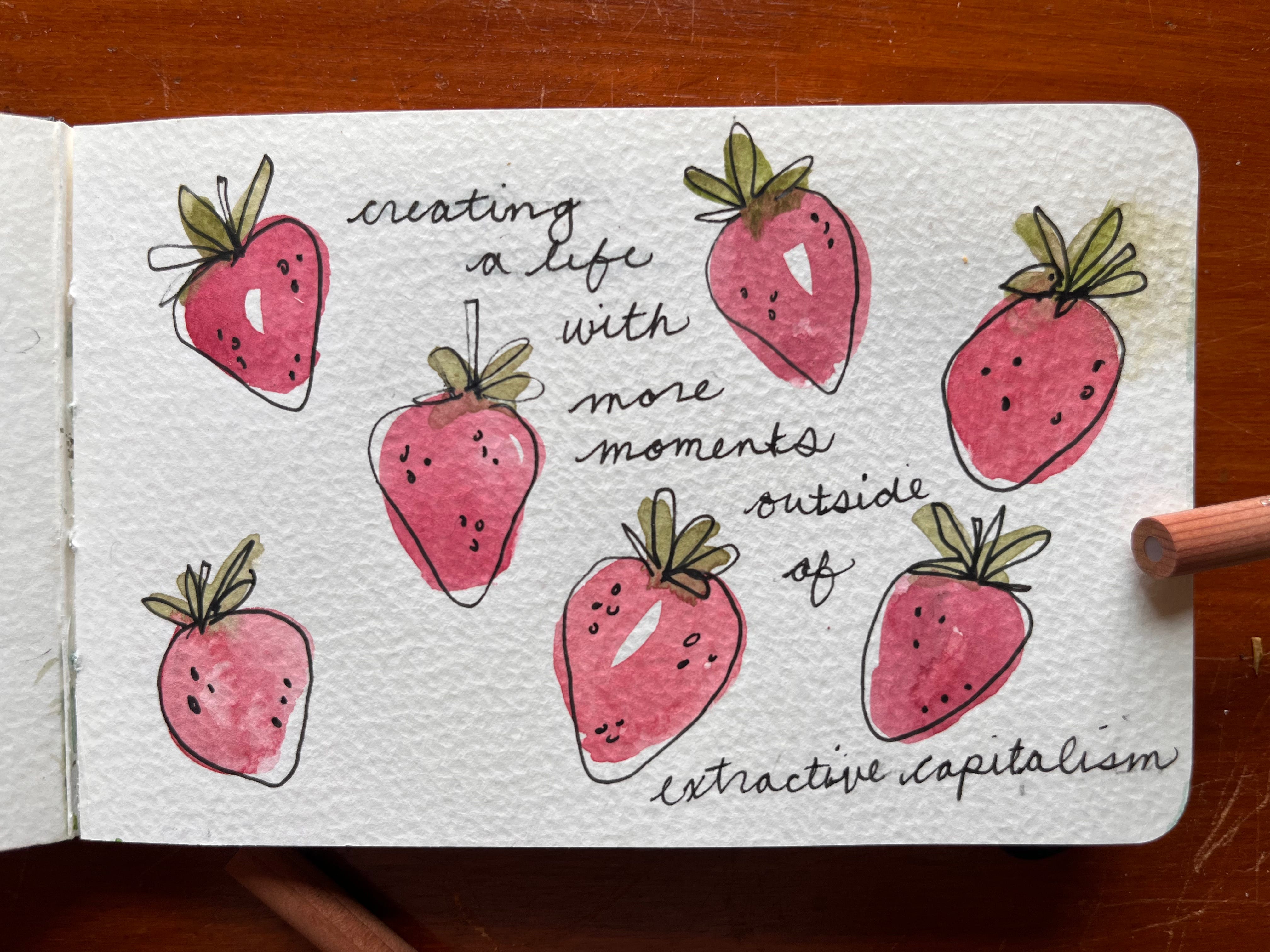
Spinks goes on to further articulate her goal in words that have been knocking around in my skull all day: “creating a life with more moments that sit outside the framework of extractive capitalism, even if I can’t escape it completely.”
Many of the highlights of my days take place in the realm outside extractive capitalism: gardening, harvesting produce for the community fridge, delivering said produce with my secondhand bike trailer, petting animals, park walks, lake swims, spending time with friends.
I am currently on a last-minute retreat, staying with my friends in the country just outside Toronto. I spend my days walking their puppy in the forest, reading, writing, painting with watercolours, gazing at plants and listening to birds and trying to absorb it all on a cellular level. I just watched a single wild turkey strut down the road in front of me. (Nature is occasionally funny.) I feel stimulated in the right way; what’s happening on Instagram feels like none of my business. At night we all dine together on the screened-in porch, and then I read a little and sleep deeply. It is peaceful. It is perfect. It is a great luxury.


It also exists outside extractive capitalism: the exchange of this stay is rooted in the gift economy. It is relational, not transactional, as Antonia Malchik has described. Next weekend my partner and I will go stay at a friend’s family cottage. More relational generosity. These stays still take place in a capitalist landscape, of course, but they are undermining the idea that every transaction should be monetized. (I wrote about one such exchange in the Substack Notes section recently: Check it out and then read about the sequel.)
Hem, hem, you may say, this is an environmental newsletter. Well, for one thing, negative environmental impacts rise with your affluence. (This is partially because of the eco impacts of investments — another reason to green your portfolio, as we’ve discussed before.) Also, “work time reductions [shorter workweeks] tend to be associated with emission reduction,” according to economist Juliet Schor. This comes from fewer travel miles and less “convenience consumption.” If the whole company has a shorter workweek, there are also operational emissions savings from that day of closure.

For me, choosing to earn less means honouring my physical and emotional health. It means less time consuming and more time creating, less time in Track Changes and more time making changes.
It also gives my mind space to breathe, to take stock of what matters. If I think back to my ethical and philosophical evolution (some might say radicalization) over the last decade, it came from having time to read and write, space to think, time to do mutual aid and community projects.
Here is the excellent Kate J. Neville, whose book Going to Seed I’ve quoted before, and I’m going to quote one of the same passages again:
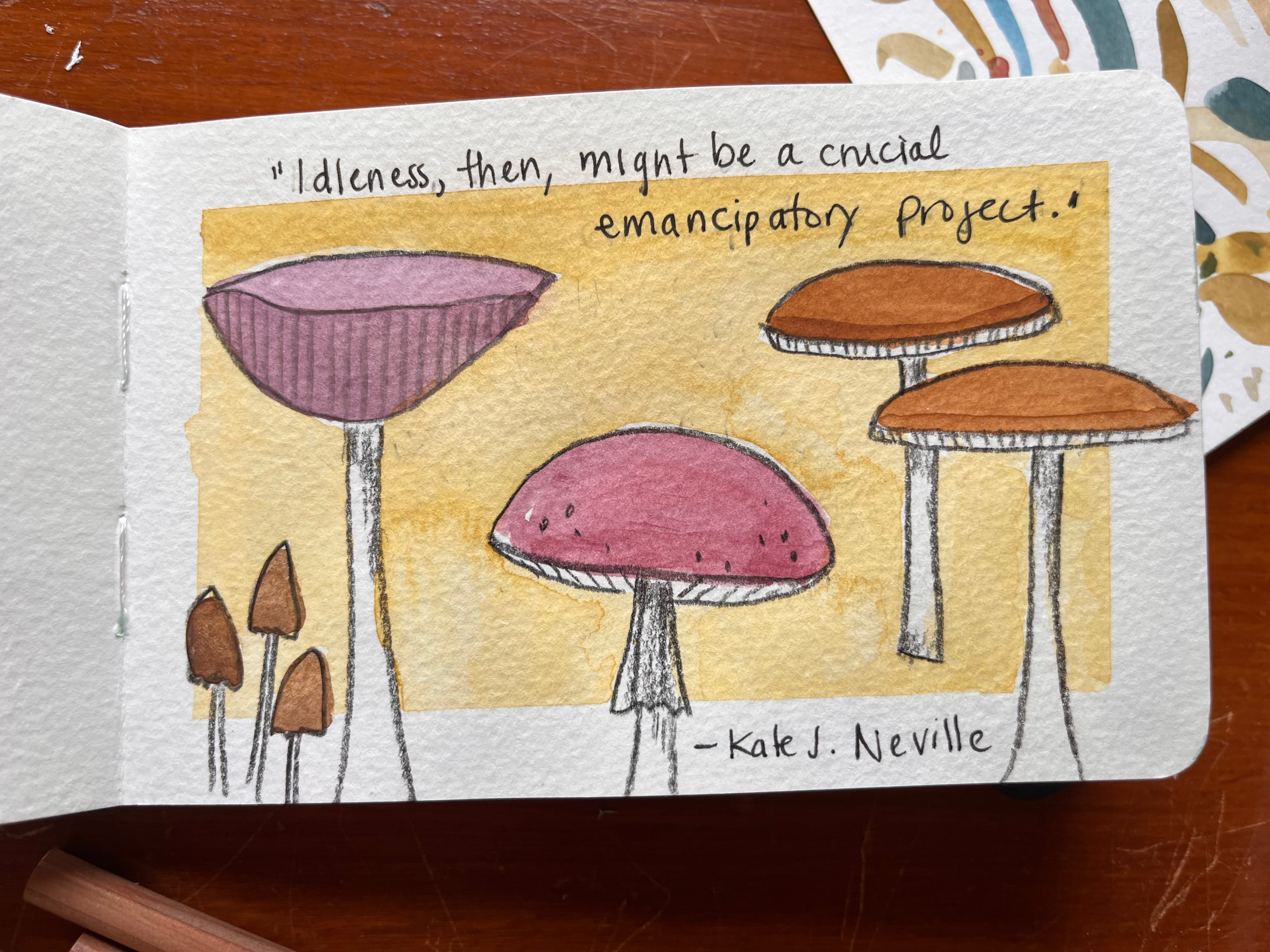
Being constantly occupied, whether in waged labour or in commercialized forms of leisure, leaves no space to form our own values and views and ethical judgements, and so leaves us ill-equipped to contribute to a collective social and political life. Instead, we are too harried to mount any challenge to inequity, servility, creeping authoritarianism or even its fully fledged version. Idleness, then, might be a crucial emancipatory project.
Like many others, I worry that with all the travails of late-stage capitalism, the relentless optimizing of the online era, we’re so busy solving little problems we’re ignoring the big ones. (To say nothing of the fact that we are not giving away years of our lives to our seductive little distraction machines, watching the world instead of participating in it.)
Being time-rich also gives me space for the smaller eco actions that sometimes are a bit more work. (Although not always more work — it takes less time to mend the broken strap on a dress than to earn the money to buy a new one.) That work is important though: These are the ways I live my values. And aligned action (as opposed to mandated action or rote action) is intrinsically satisfying. Perhaps you’ve taken a yoga class and gotten a crucial physical adjustment from the teacher. Suddenly a door clicks open. Oh.
Each of these aligned actions can be like flowers on a garland: each beautiful, but together enchanting. (I initially typed “enchanging” there, which is not a word, but perhaps should be?)
Let’s go back to Neville:
Shortening work weeks and building bike lanes and tending gardens and repairing our clothes and our tools and our technologies are, each one, a limited act in a specific workplace or community or home — but destruction also takes place one act and one place at a time. Extraction and demolition have mostly stopped seeming radical to many people, since they are so common, and so the cumulative impact of unrelenting quotidian damage all adds up. But even feller-bunchers can only raze one cutblock at a time, and sometimes, if rarely, they leave a lone Douglas fir standing. Each act of refusal, each moment of resisting the frenzy of producing and consuming, each time we notice a skylark’s aerial abandon, we create new political spaces, new possibilities for our shared world.
Sometimes I make jokes about the death of my ambition. But that’s just my career ambition, and it’s not dead, it’s just sleeping. I still want to produce great, meaningful books in my little corner of the industry, and I can do that right where I am. My ambition has actually gone to seed, expanded beyond bullet-form updates to my LinkedIn profile. It is bigger than me. There is so much I want to see and be a part of: ecological restoration, urgent climate action, increased food security, garden education, community connection, stronger relationships.
I’m not against ambition, I just want to think about it more expansively and to divorce it from money or status. Let’s be try to be better friends, aunties, activists, star gazers, dog walkers, bird watchers, pie bakers, readers, nappers.
Now, I have a walk in the woods to go on. Perhaps, if you’re feeling ambitious, you’ll do the same.
Parting wisdom
Alice Walker on becoming ill, and her friend coming to care for her:
In the pause of this moment I thought of the blessing it is to have a home; to be warm and sheltered. To be cared for. I said to my friend: it is possible for everyone on earth to have this. It is not some distant fantasy, it is a reality. It is the pause that gives us this clarity, this certainty. It is our time of gathering the vision together, of reminding ourselves of what we want for ourselves and how we want the same for everyone. This is the vision most in danger of becoming extinct in our time: that what we enjoy and want for ourselves is possible for all; that this is the reality we must work toward.
The pause, so brief — if only in retrospect — gives us a wonderful intuitive knowing about abundance.
— We Are the Ones We Have Been Waiting For
Karen Walrond on bringing light (which is to say goodness and change) to the world:
And if light can be made, it can be practiced. We can mindfully identify and call on the gifts and skills and experiences that we already have, the talents and traits that already bring joy to our lives, the things that “light us up” — and ritualize them. We can use them in ways that serve the world while simultaneously helping us to maintain our determination, cultivate resilience, and even tend to our own spirits. And by being purposeful in using our gifts and talents as fuel for our commitment to serve, even in a world of tremendous pain and injustice, we can minimize the possibility of burnout — or even avoid it altogether.
— The Lightmaker’s Manifesto
As I mentioned, I’m experimenting with the Notes feature of Substack, because I can optimize my engagement and grow my readership through vertical integration— lol, just kidding. It allows me to share small observations, often glimmers of the world I want to see. I’m using it as a sort of gratitude practice, and also to highlight encouraging people and things, a tiny counterpoint to the negativity bias of the media and our brains. I’m also finding it a slow, quiet, thoughtful social media space. Maybe stop by. (Or go listen to some birds instead. Even better.)
As always, your support for this newsletter is what keeps it going. A little act of digital reciprocity goes a long way: hit that heart, leave a comment (maybe what you’d like to get ambitious about), drop me a note, let me know you’re here. And if you know someone who might like these missives, please forward them on.
Take care, friends. Wishing you a soft, spacious summer.
JK
P.S. In Toronto we earned a major victory last week: The Feds shut down the Toronto Island airport jet expansion that it seems very few people wanted beside our corrupt buffoon premier. The victory was so swift a planned protest pivoted into a celebration. With all the damage Ford has wrought on education, health care, and the environment, it’s hard to remember sometimes there have still have been victories: the Greenbelt, the bike lanes, and now the airport. Thanks to everyone who spoke out. Keep fighting. Sometimes you might even win.
Five Minutes for Planet is written by me, Jen Knoch, and edited by Crissy Boylan. Words and images © Jen Knoch, 2026. As always, it’s 100% human-generated.
Once, when my kids were small and I was packing up a house to move, and my husband had taken the kids to his mom's, and I thought I didn't have much left to do (but I did!), a neighbour showed up, fed me, invited me to sleep at her house, and drove me around to do errands. I will NEVER forget that kindness. She told me she liked having the kind of life where she had time for others. I think of that often.
Beautiful post Jen! I’m with you on being wary of pursuing a little more money in exchange for a lot more work, but the pressure is very real. Deciding we have enough feels pretty radical but the alternative is nutty.